













Explore tips and tricks from fellow Guides and the GUIDEcx team!
Recently active
Hey! I am supporting a startup who is developing a dating app. I am helping them to create their Onboarding and Customer Success plans to they can implement the appropriate processes and systems to support them as they scale. I am curious if anyone has any experience or can recommend any tools they would imagine might be able to support their team!
Hey everyone, We use GuideCX as primarily an Onboarding/Implementation project management tool. During our Kick Off Meeting with the customers we go through a slide deck with a series of Requirement Questions. For ease of viewing I use Google Slides to list the Questions. I don’t want to go out of presentation mode to stop and type up their answer - but instead will go back through the meeting transcript later to gather and document all the answers.My question is this - where do you all store your Requirements information that you gather? Our requirements are pretty simple - no need for a huge complex document. It doesn’t make any sense to go back and put it in Google Slide deck - no one will ever open that file again. I currently put it in meeting notes - in the Kick Off Task - but that also would be difficult to easily find and get back to.I was considering like a Google Sheet that is attached to the project. I think I read where I can set up with the project initiation recipe
We have been using GUIDEcx for just over a year. We are using it for SaaS software implementations at the Enterprise level. Our implementation plans are long and complicated. We would LOVE to chat with other GUIDEcx customers that are using it at this level as well. I am sure there are things we are doing that could be done differently or better, but we really need the perspective of someone using it in the same way. Anyone willing to chat with me?
Hello, all! I’m trying to create KPIs/Metrics that will help drive the right behaviors in GuideCX by my internal team members. What kinds of metrics are you all using to do this?For example, I’m going to use the Task Efficiency Report to identify patterns of late tasks for team members. This will enable me to have a conversation with the individual and ask what blockers they are facing to getting tasks done on-time.Any other ideas on what reports/metrics you’re using to drive good planning, communication, execution, etc. within Guide? Thanks in advance!
Hi! One of my customers brought to my attention the confusion of the PM Note of an overview. I never really thought about it as I craft these each Sunday before they launch on Monday, but I am now seeing that each recipient gets the communication as if I am talking directly to them! It makes sense, but I don’t think I ever fully put it together until this very moment.I was thinking it might be nice to have a primary and then secondary notifications – meaning the main person you are working with vs the others. Since you can only assign a task to one person, what if you could designate 1 person for the overview or create a cc for those less involved?Also, I am looking forward to hear any best practices around this effort so that I can improve things.Please let me know.Thanks! Jenny Tracy
Yesterday we had the pleasure of having @annalise Arvelo join us for a webinar to share how Quantum Metric has scaled to $100M in revenue and created an onboarding process to match the sophistication of their new customers.If your missed it, you can watch “David Onboarding Goliath: Scaling Exponential Growth” here ➡️ https://bit.ly/3XqC9O5During the webinar Anna Lise asked the audience, "What in your village needs to be burned down?".In other words, what is no longer serving you any more? At Quantum Metric they implemented “Meeting Doomsday” - canceling internal meetings for 2 weeks then taking an audit of every internal and external meeting.What is the value? What are the tangible outputs? How are we measuring success?After reviewing feedback and impact, only meetings that were deemed essential were added back to the calendar.What are you doing to make space for your team to determine what should be burned in your village? -----If you want to try “Meeting Doomsday” at your org, check
One area that I consistently struggle in my GuideCX Project Plan is interacting with the customer to schedule their Implementation Kick Off and User Training meetings. I’ve been striving to keep all of my communication with the customer coming from GuideCX if possible - so it reflects the total picture of the history of the project. I have a task that is assigned to the customer called Schedule your Implementation Kick Off Meeting!” and in it - I have embedded a Calendly Link to my calendar so that they can select an available time that works for them. But I have found that I have a better response rate for scheduling if I utilize the Calendly feature where you can actually insert availability that they can select and schedule quickly. So sometimes I reply to the task email from GuideCX and add that availability if I haven’t heard from them. Can anyone share how they handle meeting scheduling with their customers through the GuideCX project?
I’m sure I’m not the only one who is getting asked about how we can improve our AI usage at their company. Since guideCX is a critical platform for my teams, I’m curious if anyone has started to leverage AI to help increase efficiency in the use of the guideCX platform? I’m not necessarily sure where the value could lie directly, so any out of the box use cases people would be open to sharing would be really cool to hear. Would love to get some inspiration 🤓
I’m currently redesigning some onboarding flows for my new company. Here’s my framework. Feel free to steal it or let me know what you would add/take away!
I’m looking for inspiration on how others name their GuideCX Projects. With the original basic interface with HubSpot - the GuideCX Project Name would match the Deal Name in HubSpot. Now with the new Recipe Builder we have complete control over Project Naming and I would like to take advantage of that.I think the Deal Name is a bad idea because it isn’t “user friendly” and it’s long. Here’s an example Center for American Progress - 6 Tuners + MTVH + 1 Custom Stream + 50 Event HoursSo that is really silly in all of the GuideCX emails to the customer referring to the project. I think it’s important that it has the Customer’s Name in it (for our benefit) and our name in it (for the customer’s benefit. But other than that - do you add anything else? I’ve been playing around with this scheme - but it still gets kind of lengthy[Customer Name} - SnapStream [Purchase Type] - [Platform]Big Boy Agency - SnapStream - New - Cloud w/ Managed TV Hosting So what do you all do? Show me your Pro
My team has a very dialed onboarding process. However, our account management/ongoing customer success program could use some TLC. Can anyone in this community point me to some resources that can help us learn about best practices for customers outside of onboarding? We are looking for recommendations on PLN’s, books, articles, podcasts, blogs, etc. that you have found beneficial. Thank you in advance!
Want to learn more about Status Change Reasons? Check Out our Status Change Reasons Help Article to start setting up today!
Q: I would like to have a record of emails being sent to my customers; how do I do that?A: There are several ways to accomplish this:By leveraging WATCHER functionality. By leveraging the GLOBAL BCC functionality. By leveraging the PROJECT LEVEL BCC functionality.You can deploy any combination of the above as needed; please review the help articles linked above for full details! OVERVIEW:Leveraging WATCHER functionality:Whenever you want activity associated with a given task to cc. a certain stakeholder, consider leveraging WATCHERs. You can add yourself as a WATCHER, and/or add additional users as WATCHERs. Increasing visibility will increase accountability by adding team members to mission-critical tasks. Stakeholders can be added as watchers to tasks where they are not contributing directly to ensure there aren't hiccups along the customer onboarding experience! Watchers receive emails whenever something interesting happens to a task - assignee changes, attachments are added, notes
We have a great kickoff call agenda and slide deck, but it does not include a Customer Success Plan which we are contemplating adding. Does anybody out there have any best practices around the CS Plan or have a template to share? I’d love to hear your input!
Curious as to if there are any tips / formats / standard y’all follow will filling out RFPs that ask for a breakdown of implementation services? I provide a high level breakdown of our different phases and a few short sentences as to what is required within each phase. When it comes to time commitments, I struggle to put accurate numbers as I want to be realistic but also don’t want to scare the prospect off as to what will actually be required of them.
Customer onboarding, is the most crucial phase in the interaction between customers and a brand, because it holds immense significance for overall success.Fortunately it’s essential. Overlook your onboarding experience and your retention will suffer.Unfortunately it’s viewed as a cost center.Why is that the reality? Here are the top two reasons (I’d love to hear your thoughts too)Resource Allocation: Onboarding requires people, tools, and time. Customization + Integrations: Depending on the complexity of your product or service, onboarding may require customization or integration efforts to meet the specific needs of each customer, adding to the overall cost.How can we change that narrative? Here are some ideas I have, but please share your thoughts below!Emphasize the Long-Term Benefits: Measure things like customer retention, CSAT, and lifetime value. Quantify the ROI: Gather data around churn rates, upsells, and customer referrals. Align with Business Goals: A well-executed onboardi
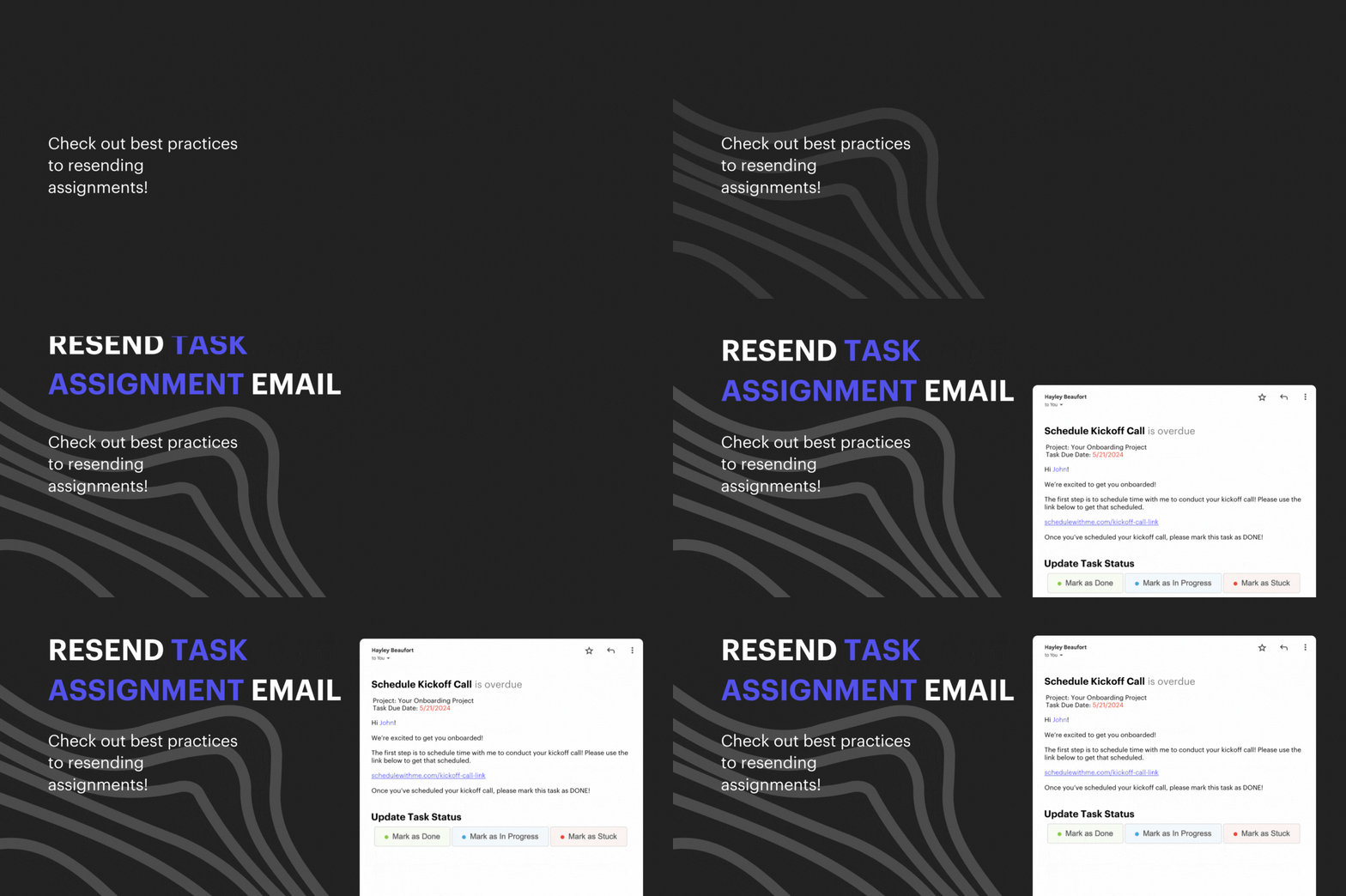
Sometimes tasks run late because the assignee might miss the assignment emails or overdue reminders flowing in their inboxes.A classic case is when a user is back from a long leave! Sending gentle reminders to Task Assignee is just a click easy! Best PracticeBefore resending the task assignment email, we recommend that you always @mention the assignee in the task notes and give them a heads up that you're sending the task again so it doesn't get lost!Below is an example: FAQsCan I send Task Assignment emails for tasks where dependency is not met?Yes, whether or not dependencies are met (even hard dependencies) you can send the reassignment email and it will appear in the inbox.Why is the date-time stamp of resent email not updating to the recent most email that was sent?If the task assignment email has been sent previously using this option to re-send the assignment email the Date and time stamp that appears in the task details will only show the date and time of when the assignment wa
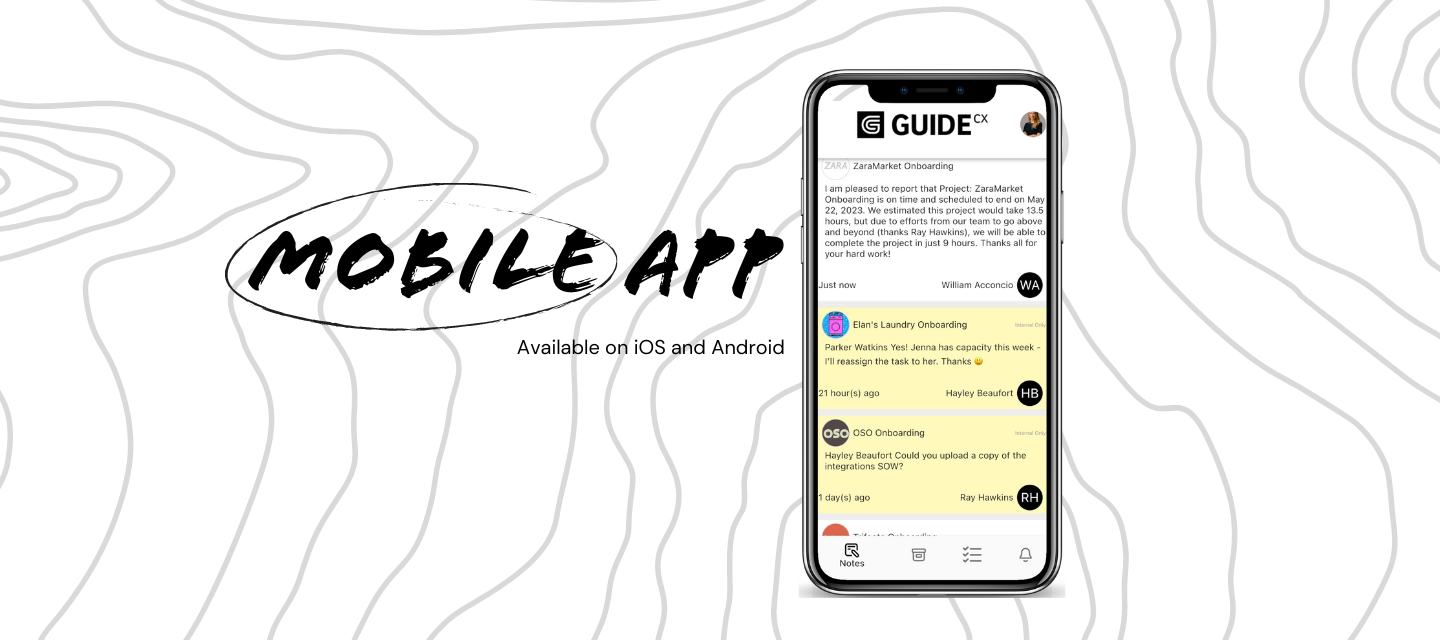
Whether you're at your desk or not, onboarding doesn't stop.With the GUIDEcx Mobile App, you can drive project success from anywhere, at anytime.Stay in the loop with easy collaboration, one-click task updates, and instant alerts.You can download the apps here:On iOS On Android4 Tips to Get the Most Out of Your New AppTip 1: Update your mobile notification settings within the web-appGo to app.guidecx.com and click on the three-dot menu next to your company name in the navigation rail. Select Profile Settings > Notifications. Tip 2: Create saved project and task filters in the web app so they can be accessed via the mobile app Tip 3: Be sure to “Allow Push Notifications” when prompted after login to the mobile app, so you can get time sensitive action items via push notifications.Get notified when a task status is updated to stay informed on project progress, see when a user leaves a new task or project note, and more! Tip 4: Utilize the “Notes Digest” view to see all communication
Hi All,I am looking at using Guide CX in a Training Consultant role. Does anyone have a template they created for this role using Guide CX?
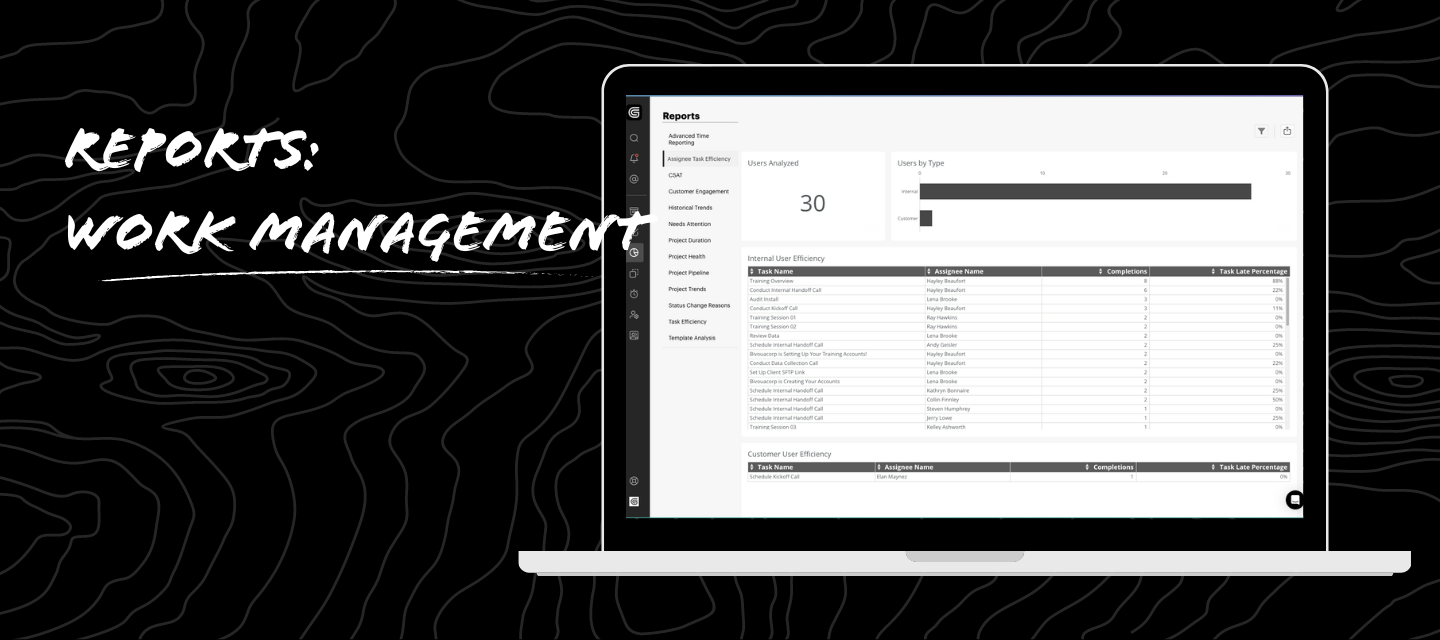
Enhance your work by using GUIDEcx reports to identify what needs your attention.Needs Attention will tell you if there are any unassigned tasks that need your attention.Assignee Task Efficiency can serve as a personal scorecard that you check weekly to be the best you can be!I’d love to hear your favorite way to use reports to ensure nothing slips through the cracks!
Pop quiz! This template takes 53 days on average to complete. What are a few things you would do to reduce the duration?Drop your ideas below!
Hello All, My team has customers with a bunch of sites/locations where each site needs an entire project plan to onboard. How do you manage those using GCX? I’m just curious what other customers are doing to keep this organized and ensure the visibility for internal users and customers alike is simple as well as how you manage them functionally. Thanks in advance!
Onboarding people is hard.Onboarding busy people is even harder.The secret to engaging busy people is to communicate more clearly.I’m always on the look out for content that is applicable to customer onboarding. I found this webinar from the Harvard Kennedy School that talks about “The Science of Corresponding with Busy People.”Todd Rogers, a behavioral scientist and professor of public policy at Harvard Kennedy School shares his take on the five principles for effective communication and how to implement them in your writing (emails, task instructions, meeting recaps, etc).The 5 principles Todd shared are:Use fewer words. Less is more. Get to the point faster to get people to higher engagement. Decrease reading-level. Making it easier to read will increase engagement. Format to direct attention. Formatting can highlight what the writer thinks is most important. Use it judiciously. Make key information obvious. The point of the communication should be obvious. Don’t make it a maze to f
Onboarding people is hard.Onboarding busy people is even harder.The secret to engaging busy people is to communicate more clearly and make it easy to be onboarded.Resources:1. Download the magical chrome extension for templatizing your meeting recaps!2. Brush up on the 5 Principles of Communication3. Have questions? Ask them in the GUIDEcx community!
The best GUIDEs are organized. Thankfully with GUIDEcx, there's more ways to stay organized. Today I want to share a tip that helped me know within seconds who needed my attention and who didn't need as much handholding. Back in my early onboarding days I had a weekly meeting with my CEO to discuss three things: Which customers were at risk, Why they were not progressing quickly, and Which ones were healthy. I always dreaded this meeting because it took too long to prepare for it. I wish I had GUIDEcx at the time because of the Project Tag feature. When I learned that I could tag projects as "🐌" for "Slow Moving" it became a game changer. With GUIDEcx, I can tag and filter between truly healthy customers and customers who were just slow moving and not at risk. Other ways I've seen tags get used is to identify what kind of service package was purchased. Not only does it help the onboarder immediately know what kind of service the c
Already have an account? Login
No account yet? Create an account
Enter your E-mail address. We'll send you an e-mail with instructions to reset your password.